
- Nike sneakers
- Sports Shoes
- Mysneakers
- Sportswear Design
- Best Sneakers
- nike kyrie 7 expressions dc0589 003 release date info
- jordan 1 retro high og university blue ps aq2664 134
- Air Jordan 12 FIBA 130690 107 2019 Release Date 4 1
- Air Jordan 4 DIY Kids DC4101 100 Release Date 4
- air jordan 1 atmosphere white laser pink obsidian dd9335 641 release date
- Home
- Articles Archive, 2006-2016
- Golden Oldies
- 2016-2026 Articles Archive
- A Study of Dom Prosper Gueranger's Detailed Defense of The Mystical City of God Now Published in Kindle and Paperback
- About This Site
- As Relevant Now as It Was One Hundred Six Years Ago: Our Lady's Fatima Message
- Donations (October 7, 2025)
- Now Available for Purchase: Paperback Edition of G.I.R.M. Warfare: The Conciliar Church's Unremitting Warfare Against Catholic Faith and Worship
- Ordering Dr. Droleskey's Books
- US Coalition for Life Appeal to Help the Catholics of the Holy Land
Pachamama Bob Prevost and Sarah Mullally, part two
Let me dispense with the preliminaries concerning the false, heretical, and schismatic nature of the Anglican sect:
First, this false church was started the when the syphilitic, adulterous, incestuous, bigamous, murderous and drunken glutton named King Henry VIII had Parliament declare himself to the “supreme head of the church in England” in 1534 so that he could marry his mistress, Anne Boleyn, who was, some historians assert, his own illegitimate daughter (which would explain a lot about Queen Elizabeth I).
Second, Henry VIII required everyone within the English realm to take an oath of loyalty to himself as the head of the “Church of England” and thence embarked thirteen years of the relentless arrest, torture, and execution of over 72,000 Catholics in England and Ireland between 1534 and 1547 who refused to betray Our Blessed Lord and Saviour Jesus Christ and His true Church.
Third, Henry VIII seized churches, convents, and monasteries, threw off the poor who farmed the monastery and convent lands in exchange for living on those properties and providing a share of their crops to the priests and religious in those monasteries and convents, thereby the creating a class of the homeless poor whose descendants would be exploited during the Industrial Revolution three centuries later, distributed the stolen lands to his political allies to make them and their own descendants who would be loyal to the Protestant Revolution, and instilled a hatred for the nearly everything to do with Catholic England of the previous nine hundred years in favor of a new secular and religious order, a veritable novus ordo, if you will.
Henry had Parliament enact various laws to force the poor who had lived for a nominal annual fee on the monastery and convent lands (as they produced the food to sustain themselves, giving some to the monastery or convent) off of those lands, where their families had lived for generations, in order to redistribute the Church properties that he had stolen to those who supported his break from Rome. Henry quite cleverly created a class of people who were dependent upon him for the property upon which they lived and the wealth they were able to derive therefrom, making them utterly supportive of his decision to declare himself Supreme Head of the Church in England. Those of the poorer classes who had been thrown off of the monastery and convent lands were either thrown into prison (for being poor, mind you) or forced to migrate to the cities, where many of them lost the true Faith and sold themselves into various vices just to survive. The effects of this exercise of state-sponsored engineering are reverberating in the world today, both politically and economically.
Indeed, many of the conditions bred by the disparity in wealth created by Henry's land grab in the Sixteenth Century would fester and help to create the world of unbridled capitalism and slave wage that so impressed a German emigre in London by the name of Karl Marx. Unable to recognize the historical antecedents of the real injustices he saw during the Victorian Era, Marx set about devising his own manifestly unjust system, premised on atheism and anti-Theism, to rectify social injustice once and for all. In a very real way, Henry Tudor led the way to Lenin of Russia and to the European Union as the sterile substitute for the Social Kingship of Our Blessed Lord and Saviour Jesus Christ.
Fourth, the nature of error being what it is, the so-called “Anglican Church” developed its own Protestant theology, which included one of the chief cornerstones of Protestantism, acceptance of divorce and remarriage in full contravention of the words Our Blessed Lord and Saviour Jesus Christ taught, and liturgical rites, beginning with the Edwardian Ordinal up to the present time that are sacramentally barren and liturgically invalid on their very face:
Pius Bishop, servant of the servants of God, in lasting memory of the matter.
He that reigneth on high, to whom is given all power in heaven and earth, has committed one holy Catholic and apostolic Church, outside of which there is no salvation, to one alone upon earth, namely to Peter, the first of the apostles, and to Peter’s successor, the pope of Rome, to be by him governed in fullness of power. Him alone He has made ruler over all peoples and kingdoms, to pull up, destroy, scatter, disperse, plant and build, so that he may preserve His faithful people (knit together with the girdle of charity) in the unity of the Spirit and present them safe and spotless to their Saviour.
1. In obedience to which duty, we (who by God’s goodness are called to the aforesaid government of the Church) spare no pains and labour with all our might that unity and the Catholic religion (which their Author, for the trial of His children’s faith and our correction, has suffered to be afflicted with such great troubles) may be preserved entire. But the number of the ungodly has so much grown in power that there is no place left in the world which they have not tried to corrupt with their most wicked doctrines; and among others, Elizabeth, the pretended queen of England and the servant of crime, has assisted in this, with whom as in a sanctuary the most pernicious of all have found refuge. This very woman, having seized the crown and monstrously usurped the place of supreme head of the Church in all England to gather with the chief authority and jurisdiction belonging to it, has once again reduced this same kingdom- which had already been restored to the Catholic faith and to good fruits- to a miserable ruin.
Prohibiting with a strong hand the use of the true religion, which after its earlier overthrow by Henry VIII (a deserter therefrom) Mary, the lawful queen of famous memory, had with the help of this See restored, she has followed and embraced the errors of the heretics. She has removed the royal Council, composed of the nobility of England, and has filled it with obscure men, being heretics; oppressed the followers of the Catholic faith; instituted false preachers and ministers of impiety; abolished the sacrifice of the mass, prayers, fasts, choice of meats, celibacy, and Catholic ceremonies; and has ordered that books of manifestly heretical content be propounded to the whole realm and that impious rites and institutions after the rule of Calvin, entertained and observed by herself, be also observed by her subjects. She has dared to eject bishops, rectors of churches and other Catholic priests from their churches and benefices, to bestow these and other things ecclesiastical upon heretics, and to determine spiritual causes; has forbidden the prelates, clergy and people to acknowledge the Church of Rome or obey its precepts and canonical sanctions; has forced most of them to come to terms with her wicked laws, to abjure the authority and obedience of the pope of Rome, and to accept her, on oath, as their only lady in matters temporal and spiritual; has imposed penalties and punishments on those who would not agree to this and has exacted then of those who persevered in the unity of the faith and the aforesaid obedience; has thrown the Catholic prelates and parsons into prison where many, worn out by long languishing and sorrow, have miserably ended their lives. All these matter and manifest and notorious among all the nations; they are so well proven tweevasion.
3. We, seeing impieties and crimes multiplied one upon another the persecution of the faithful and afflictions of religion daily growing more severe under the guidance and by the activity of the said Elizabeth -and recognizing that her mind is so fixed and set that she has not only despised the pious prayers and admonitions with which Catholic princes have tried to cure and convert her but has not even permitted the nuncios sent to her in this matter by this See to cross into England, are compelled by necessity to take up against her the weapons of justice, though we cannot forbear to regret that we should be forced to turn, upon one whose ancestors have so well deserved of the Christian community. Therefore, resting upon the authority of Him whose pleasure it was to place us (though unequal to such a burden) upon this supreme justice-seat, we do out of the fullness of our apostolic power declare the foresaid Elizabeth to be a heretic and favourer of heretics, and her adherents in the matters aforesaid to have incurred the sentence of excommunication and to be cut off from the unity of the body of Christ. (Regnans in Excelsis, the decree issued by Pope Saint Pius V on March 5, 1570, excommunicating Queen Elizabeth I.)
24. In the examination of any rite for the effecting and administering of Sacraments, distinction is rightly made between the part which is ceremonial and that which is essential, the latter being usually called the “matter and form”. All know that the Sacraments of the New Law, as sensible and efficient signs of invisible grace, ought both to signify the grace which they effect, and effect the grace which they signify. Although the signification ought to be found in the whole essential rite, that is to say, in the “matter and form”, it still pertains chiefly to the “form”; since the “matter” is the part which is not determined by itself, but which is determined by the “form”. And this appears still more clearly in the Sacrament of Order, the “matter” of which, in so far as we have to consider it in this case, is the imposition of hands, which, indeed, by itself signifies nothing definite, and is equally used for several Orders and for Confiirmation.
25. But the words which until recently were commonly held by Anglicans to constitute the proper form of priestly ordination namely, “Receive the Holy Ghost,” certainly do not in the least definitely express the sacred Ordel of Priesthood (sacerdotium) or its grace and power, which is chiefly the power “of consecrating and of offering the true Body and Blood of the Lord” (Council of Trent, Sess. XXIII, de Sacr. Ord. , Canon 1) in that sacrifice which is no “bare commemoration of the sacrifice offered on the Cross” (Ibid, Sess XXII., de Sacrif. Missae, Canon 3).
26. This form had, indeed, afterwards added to it the words “for the office and work of a priest,” etc.; but this rather shows that the Anglicans themselves perceived that the first form was defective and inadequate. But even if this addition could give to the form its due signification, it was introduced too late, as a century had already elapsed since the adoption of the Edwardine Ordinal, for, as the Hierarchy had become extinct, there remained no power of ordaining.
27. In vain has help been recently sought for the plea of the validity of Anglican Orders from the other prayers of the same Ordinal. For, to put aside other reasons when show this to be insufficient for the purpose in the Anglican life, let this argument suffice for all. From them has been deliberately removed whatever sets forth the dignity and office of the priesthood in the Catholic rite. That “form” consequently cannot be considered apt or sufficient for the Sacrament which omits what it ought essentially to signify.
28. The same holds good of episcopal consecration. For to the formula, “Receive the Holy Ghost”, not only were the words “for the office and work of a bishop”, etc. added at a later period, but even these, as we shall presently state, must be understood in a sense different to that which they bear in the Catholic rite. Nor is anything gained by quoting the prayer of the preface, “Almighty God”, since it, in like manner, has been stripped of the words which denote the summum sacerdotium.
29. It is not relevant to examine here whether the episcopate be a completion of the priesthood, or an order distinct from it; or whether, when bestowed, as they say per saltum, on one who is not a priest, it has or has not its effect. But the episcopate undoubtedly, by the institution of Christ, most truly belongs to the Sacrament of Order and constitutes the sacerdotium in the highest degree, namely, that which by the teaching of the Holy Fathers and our liturgical customs is called the Summum sacerdotium sacri ministerii summa . So it comes to pass that, as the Sacrament of Order and the true sacerdotium of Christ were utterly eliminated from the Anglican rite, and hence the sacerdotium is in no wise conferred truly and validly in the episcopal consecration of the same rite, for the like reason, therefore, the episcopate can in no wise be truly and validly conferred by it, and this the more so because among the first duties of the episcopate is that of ordaining ministers for the Holy Eucharist and sacrifice.
30. For the full and accurate understanding of the Anglican Ordinal, besides what we have noted as to some of its parts, there is nothing more pertinent than to consider carefully the circumstances under which it was composed and publicly authorized. It would be tedious to enter into details, nor is it necessary to do so, as the history of that time is sufficiently eloquent as to the animus of the authors of the Ordinal against the Catholic Church; as to the abettors whom they associated with themselves from the heterodox sects; and as to the end they had in view. Being fully cognizant of the necessary connection between faith and worship, between “the law of believing and the law of praying”, under a pretext of returning to the primitive form, they corrupted the Liturgical Order in many ways to suit the errors of the reformers. For this reason, in the whole Ordinal not only is there no clear mention of the sacrifice, of consecration, of the priesthood (sacerdotium), and of the power of consecrating and offering sacrifice but, as we have just stated, every trace of these things which had been in such prayers of the Catholic rite as they had not entirely rejected, was deliberately removed and struck out.
31. In this way, the native character or spirit as it is called of the Ordinal clearly manifests itself. Hence, if, vitiated in its origin, it was wholly insufficient to confer Orders, it was impossible that, in the course of time, it would become sufficient, since no change had taken place. In vain those who, from the time of Charles I, have attempted to hold some kind of sacrifice or of priesthood, have made additions to the Ordinal. In vain also has been the contention of that small section of the Anglican body formed in recent times that the said Ordinal can be understood and interpreted in a sound and orthodox sense. Such efforts, we affirm, have been, and are, made in vain, and for this reason, that any words in the Anglican Ordinal, as it now is, which lend themselves to ambiguity, cannot be taken in the same sense as they possess in the Catholic rite. For once a new rite has been initiated in which, as we have seen, the Sacrament of Order is adulterated or denied, and from which all idea of consecration and sacrifice has been rejected, the formula, “Receive the Holy Ghost”, no longer holds good, because the Spirit is infused into the soul with the grace of the Sacrament, and so the words “for the office and work of a priest or bishop”, and the like no longer hold good, but remain as words without the reality which Christ instituted.
32. Many of the more shrewd Anglican interpreters of the Ordinal have perceived the force of this argument, and they openly urge it against those who take the Ordinal in a new sense, and vainly attach to the Orders conferred thereby a value and efficacy which they do not possess. By this same argument is refuted the contention of those who think that the prayer, “Almighty God, giver of all good Things”, which is found at the beginning of the ritual action, might suffice as a legitimate “form” of Orders, even in the hypothesis that it might be held to be sufficient in a Catholic rite approved by the Church.
33. With this inherent defect of “form” is joined the defect of “intention” which is equally essential to the Sacrament. The Church does not judge about the mind and intention, in so far as it is something by its nature internal; but in so far as it is manifested externally she is bound to judge concerning it. A person who has correctly and seriously used the requisite matter and form to effect and confer a sacrament is presumed for that very reason to have intended to do (intendisse) what the Church does. On this principle rests the doctrine that a Sacrament is truly conferred by the ministry of one who is a heretic or unbaptized, provided the Catholic rite be employed. On the other hand, if the rite be changed, with the manifest intention of introducing another rite not approved by the Church and of rejecting what the Church does, and what, by the institution of Christ, belongs to the nature of the Sacrament, then it is clear that not only is the necessary intention wanting to the Sacrament, but that the intention is adverse to and destructive of the Sacrament.
34. All these matters have been long and carefully considered by ourselves and by our venerable brethren, the Judges of the Supreme Council, of whom it has pleased Us to call a special meeting upon the 16th day of July last, the solemnity of Our Lady of Mount Carmel. They with one accord agreed that the question laid before them had been already adjudicated upon with full knowledge of the Apostolic See, and that this renewed discussion and examination of the issues had only served to bring out more clearly the wisdom and accuracy with which that decision had been made. Nevertheless, we deemed it well to postpone a decision in order to afford time both to consider whether it would be fitting or expedient that we should make a fresh authoritative declaration upon the matter, and to humbly pray for a fuller measure of divine guidance.
35. Then, considering that this matter, although already decided, had been by certain persons for whatever reason recalled into discussion, and that thence it might follow that a pernicious error would be fostered in the minds of many who might suppose that they possessed the Sacrament and effects of Orders, where these are nowise to be found, it seemed good to Us in the Lord to pronounce our judgment.
36. Wherefore, strictly adhering, in this matter, to the decrees of the pontiffs, our predecessors, and confirming them most fully, and, as it were, renewing them by our authority, of our own initiative and certain knowledge, we pronounce and declare that ordinations carried out according to the Anglican rite have been, and are, absolutely null and utterly void. (Pope Leo XIII, Apostolicae Curae, September 15, 1887.)
One of the chief ironies of the present moment, although one I came to recognize only twenty years ago this very day, April 30, 2006, fifteen and one-half years ago, sadly, is that the text of Pope Leo XIII’s Apostolicae Curae condemns not only the rites of “episcopal” consecration and presbyteral “ordination” in the false Anglican sect but also those within the counterfeit church of conciliarism.
Fifth, the Anglican sect’s endorsement of the “ordination” of women as “priests” and “bishops” in 1992, although various members of its “worldwide communion” including the Episcopal Church of the United States of America, had been doing so since the 1970s, and then as “bishops” in 2014 (some forty years after what were called “irregular ordinations” of women here in the United States) even Our Blessed Lord and Saviour Jesus Christ did not ordain women at the Last Supper as He was made Incarnate in Our Lady’s Virginal and Immaculate Womb by the power of the Third Person of the Most Holy Trinity, God the Holy Ghost, at the Annunciation as a male (men are progenitors) and thus instituted Holy Orders to continue His work as the progenitor of the Order of Redemption (Grace) He instituted at the Last Supper and ratified on the wood of the Holy Cross on Good Friday.
Obviously, a false sect can do anything it wants but, as will be discussed later in this commentary, the leaders of another false sect, the counterfeit church of conciliarism, have based their own false beliefs and invalid liturgical rites after the Anglican pattern of “synodality” and “inclusion” in its own efforts to tickle the itching ears of men with fables rather than to exhort sinners to repentance and non-Catholics to conversion.
Fifth, the Anglican sect has continued its unremitting warfare against marriage and the family that started with Henry VIII’s “divorce” from his legitimate wife, Catherine of Aragon, the daughter of Queen Isabella and King Ferdinand, and thus institutionalizing ready divorce and, three centuries later, the endorsement of contraception in 1930 and, from there, to the support of direct surgical baby-killing and sodomy and all its related, ever-permutating list of unspeakable perversities:
It is important to remember that the warfare waged by King Henry VIII against the sanctity and indissolubility of Holy Matrimony made inevitable his false religious sect’s warfare against the fecundity of marriage at its Lambeth Conference in 1930:
Resolution 15
The Life and Witness of the Christian Community - Marriage and Sex
Where there is clearly felt moral obligation to limit or avoid parenthood, the method must be decided on Christian principles. The primary and obvious method is complete abstinence from intercourse (as far as may be necessary) in a life of discipline and self-control lived in the power of the Holy Spirit. Nevertheless in those cases where there is such a clearly felt moral obligation to limit or avoid parenthood, and where there is a morally sound reason for avoiding complete abstinence, the Conference agrees that other methods may be used, provided that this is done in the light of the same Christian principles. The Conference records its strong condemnation of the use of any methods of conception control from motives of selfishness, luxury, or mere convenience. (Resolution 15 - The Life and Witness of the Christian Community - Marriage.)
This decision opened the floodgates of Protestant acceptance of contraception, which, of course, had been promoted for the previous fifteen years in the United States of America by the nymphomaniac revolutionary anti-Theist named Margaret Sanger. An organization known as the Federal Council of Churches in America (which merged in 1950 with other such organizations to form the “National Council of Churches”) endorsed contraception in 1931, prompting the following editorial to appear, amazingly enough, in The Washington Post:
The Federal Council of Churches in America some time ago appointed a committee on "marriage and the home," which has now submitted a report favoring a "careful and restrained" use of contraceptive devices to regulate the size of families. The committee seems to have a serious struggle with itself in adhering to Christian doctrine while at the same time indulging in amateurish excursions in the field of economics, legislation, medicine, and sociology. The resulting report is a mixture of religious obscurantism and modernistic materialism which departs from the ancient standards of religion and yet fails to blaze a path toward something better.
The mischief that would result from an attempt to place the stamp of church approval upon any scheme for "regulating the size of families" is evidently quite beyond the comprehension of this pseudo-scientific committee. It is impossible to reconcile the doctrine of the divine institution of marriage with any modernistic plan for the mechanical regulation of human birth. The church must either reject the plain teachings of the Bible or reject schemes for the “scientific” production of human souls. Carried to its logical conclusion, the committee’s report if carried into effect would lead to the death-knell of marriage as a holy institution, by establishing degrading practices which would encourage indiscriminate immorality. The suggestion that the use of legalized contraceptives would be “careful and restrained” is preposterous. If the churches are to become organizations for political and 'scientific' propaganda they should be honest and reject the Bible, scoff at Christ as an obsolete and unscientific teacher, and strike out boldly as champions of politics and science as substitutes for the old-time religion. ("Forgetting Religion," Editorial, The Washington Post, March 22, 1932.)
The Lambeth Conference’s Resolution 15, which prompted Pope Pius XI to issue Casti Connubii on December 31, 1930, accustomed the British people to “planned” pregnancies and opened the way to the public acceptance of one degrading practice after another over the course of time, up to and including the legalization of surgical baby-killing by means of the Abortion Law of 1967 that was passed Parliament at the behest of Prime Minister Harold Wilson. Here is a brief history of surgical baby-killing in the United Kingdom as found on the website of the Society for the Protection of the Unborn in England:
In 1938, a London gynaecologist, Aleck Bourne, tested the laws by performing an abortion on a 14-year-old girl who had been sexually assaulted by five off-duty British soldiers. Dr Bourne was a supporter of the Abortion Law Reform Association.
He was charged with an illegal abortion, and pleaded not guilty on the basis that the girl's mental health would have been adversely affected by giving birth. Dr Bourne was acquitted after the judge, Mr Justice Macnaughten, invited the jury to decide whether in acting to preserve the girl's mental health, as he saw it, the doctor's action had amounted to saving her life. The judge evidently condoned the abortion, and the jury acquitted the doctor.
The effect of the Bourne case was to give legal sanction for abortions to prevent damage to a woman's physical or mental health, a test which became interpreted more and more liberally, and which was incorporated into the Abortion Act. This marked a watershed and although medical grounds are still formally required, doctors can practice abortion virtually on request provided they claim mental health is at risk. Aleck Bourne eventually became appalled at the results of his case and became an early member of the Society for the Protection of Unborn Children.
Steel's 1967 Abortion Act
The Abortion Act was introduced by the liberal MP David Steel with the tacit support of the Labour government under Harold Wilson. Steel introduced the bill as a Private Member's Bill after drawing third place in the ballot on 12th May 1966. The bill would not have reached the statute book but for the support of the government which provided the parliamentary time needed to get the bill through. The government was sympathetic to the measure but did not want to include it in its own legislative programme. The bill was eventually given a third reading by the House of Commons on 14th July 1967, and came into force on 27th April 1968.
The operation of the Act proved controversial from the outset, and a committee of inquiry was set up under Mrs Justice Lane in 1971 to review the working of the Act. Obstetricians and gynaecologists who refused to provide abortions, were put under pressure, and although those in senior posts were protected by the 'conscience clause' in the Act others were forced out of the specialism, or out of the country, as pro-abortion officials in the Department of Health demanded that NHS hospitals should provide wide access to abortion services.
Pro-life reform attempts
Pro-life MPs sought to amend the Act, first introducing amendment bills as early as 1969. But despite numerous attempts through the 1970s and 1980s, they all failed to achieve any reform of the Act, as government ministers of various parties and Department of Health officials studiously defended the legislation and its abuse.
In 1990 the Conservative government of Margaret Thatcher introduced a bill (the Human Fertilisation and Embryology Act) to legislate for in-vitro fertilisation, and agreed to allow amendments to the Abortion Act to be attached to the bill, thereby overcoming the major obstacle to getting abortion amendments onto the statute book. This proved a miscalculation on the part of pro-life MPs, as it later became clear that the government's agenda was not to introduce any significant restriction, but to widen the abortion law to accommodate new abortion techniques and to extend abortion for disabled babies up to birth (previously it had been restricted to the point at which the baby could be born alive).
Recent efforts
Further attempts to amend the law by pro-abortion MPs were attached to a later embryology bill in 2008. These also failed for reasons that are not apparent.
Recent efforts have focused on unlawful abuses of the abortion law, such as the practice of sex-selection abortion, and the discriminatory nature of abortion for disabled babies. The policy of the Department of Health to allow "unwanted" pregnancy to be deemed a threat to mental health is another way in which the law is being treated with contempt.
Dr. Bernard Nathanson
We fed the public a line of deceit, dishonesty, a fabrication of statistics and figures ... we sensationalized the effects of illegal abortions, and fabricated polls which indicated that 85% of the public favoured unrestricted abortion, when we knew it was only 5%. We unashamedly lied, and yet our statements were quoted (by the media) as though they had been written in law. (Society for the Protection of Unborn Children.)
British authorities admitted in 2013 that over eight million children had been killed since 1967 (Over eight million abortions since 1967), although a chart found here provides statistics that date as far back as the very year of the infamous 1930 Lambeth Conference. The British Isles have been a killing field since 1534, and it is thus only logical that it has been the scene of so much carnage in recent decades. Only seventeen percent of the British people believe that the killing of preborn children by surgical means is wrong in all instances (Ipsos Mori Research Publications), a figure that is very similar to that here in the United States of America, where nineteen percent of the public believe that abortion should be illegal in all circumstances (Gallup Poll.)
By the way, good readers, perhaps it should be pointed out the august Queen Elizabeth II gave her royal assent to then Prime Minister Harold Wilson’s law that decriminalized the killing of innocent preborn children, something that her apologists might claim was her “constitutional duty” even though one’s duty to God and His Commandments come before the dictates of unjust laws. Many of these same apologists might contend that she had no choice but to give her royal assent to the Parliamentary bill legalizing the absurdity that is “marriage” between people of the same gender, but the very fact that the English Parliament, whose origins can be traced back to 1295 when England was a thoroughly Catholic kingdom, would even consider passing legislation to permit baby-killing and “gay marriage” is the consequence of the overthrow of the Social Reign of Christ the King in England and its replacement by the “church” of which the English monarch is the nominal head.
Here is what the Catholic Church teaches about supposed conflicts between the truth and “duties of state”:
10. But, if the laws of the State are manifestly at variance with the divine law, containing enactments hurtful to the Church, or conveying injunctions adverse to the duties imposed by religion, or if they violate in the person of the supreme Pontiff the authority of Jesus Christ, then, truly, to resist becomes a positive duty, to obey, a crime; a crime, moreover, combined with misdemeanor against the State itself, inasmuch as every offense leveled against religion is also a sin against the State. Here anew it becomes evident how unjust is the reproach of sedition; for the obedience due to rulers and legislators is not refused, but there is a deviation from their will in those precepts only which they have no power to enjoin. Commands that are issued adversely to the honor due to God, and hence are beyond the scope of justice, must be looked upon as anything rather than laws. You are fully aware, venerable brothers, that this is the very contention of the Apostle St. Paul, who, in writing to Titus, after reminding Christians that they are "to be subject to princes and powers, and to obey at a word," at once adds: "And to be ready to every good work."Thereby he openly declares that, if laws of men contain injunctions contrary to the eternal law of God, it is right not to obey them. In like manner, the Prince of the Apostles gave this courageous and sublime answer to those who would have deprived him of the liberty of preaching the Gospel: "If it be just in the sight of God to hear you rather than God, judge ye, for we cannot but speak the things which we have seen and heard." (Pope Leo XIII, Sapientiae Christianae, January 10, 1890.)
But in this same matter, touching Christian faith, there are other duties whose exact and religious observance, necessary at all times in the interests of eternal salvation, become more especially so in these our days. Amid such reckless and widespread folly of opinion, it is, as We have said, the office of the Church to undertake the defense of truth and uproot errors from the mind, and this charge has to be at all times sacredly observed by her, seeing that the honor of God and the salvation of men are confided to her keeping. But, when necessity compels, not those only who are invested with power of rule are bound to safeguard the integrity of faith, but, as St. Thomas maintains: "Each one is under obligation to show forth his faith, either to instruct and encourage others of the faithful, or to repel the attacks of unbelievers.'' To recoil before an enemy, or to keep silence when from all sides such clamors are raised against truth, is the part of a man either devoid of character or who entertains doubt as to the truth of what he professes to believe. In both cases such mode of behaving is base and is insulting to God, and both are incompatible with the salvation of mankind. This kind of conduct is profitable only to the enemies of the faith, for nothing emboldens the wicked so greatly as the lack of courage on the part of the good. Moreover, want of vigor on the part of Christians is so much the more blameworthy, as not seldom little would be needed on their part to bring to naught false charges and refute erroneous opinions, and by always exerting themselves more strenuously they might reckon upon being successful. After all, no one can be prevented from putting forth that strength of soul which is the characteristic of true Christians, and very frequently by such display of courage our enemies lose heart and their designs are thwarted. Christians are, moreover, born for combat, whereof the greater the vehemence, the more assured, God aiding, the triumph: "Have confidence; I have overcome the world." Nor is there any ground for alleging that Jesus Christ, the Guardian and Champion of the Church, needs not in any manner the help of men. Power certainly is not wanting to Him, but in His loving kindness He would assign to us a share in obtaining and applying the fruits of salvation procured through His grace.
The chief elements of this duty consist in professing openly and unflinchingly the Catholic doctrine, and in propagating it to the utmost of our power. For, as is often said, with the greatest truth, there is nothing so hurtful to Christian wisdom as that it should not be known, since it possesses, when loyally received, inherent power to drive away error. (Pope Leo XIII, Sapientiae Christianae, January 10, 1890.)
That the late Queen Elizabeth II “had” to obey Parliament rather than God is but a vivid proof of how England’s break from the Catholic Church and Papal Primacy led directly to the rise of the modern “democratic” state where “majorities” of one kind or another control titular monarchies rather than monarchies being restrained by the use of the Indirect Power (teaching, preaching, exhortation, admonitions) and Direct Power (sanctions, interdicts, bulls of excommunication) exercised by a pope and/or his bishops when those in civil power threatened to do that which was opposed to the good of souls and hence inimical to the maintenance of the common temporal good. English monarchs once were the good servants of the Holy Father before they became tyrants who, after much bloodletting that included a civil war in the Seventeenth Century, ultimately became figureheads for Parliamentary majorities, who have proven themselves to be quite adept at shedding as much blood as Henry VIII and Elizabeth I by means of their endorsement of and participation in needless wars, including the war that was waged against Irish Catholics (who are distinct from the Marxist Irish Republican Army) in Northern Ireland, and by the endorsement of the chemical and surgical slaughter of the innocent preborn. Debauchery and licentiousness have been endorsed by Parliamentary majorities as the Queen did her “royal duty” even though by doing so she was defying the very law of God. Then again, the whole of modern England and its false religious sect is based on the defiance of the law of God, and no Catholic should ever forget this fact, ignore it, or minimize it as inconsequential. Falsehood leads to state-sponsored terror against the lives and, more importantly, the souls of innocent human beings.
Moreover, the teleology of error is such that the Anglican sect declined over time to such an extent as to become, as noted very favorably in the Christianity Today report quoted above, nothing other than an institution of social work where matters such as the Sacred Divinity of Our Blessed Lord and Saviour Jesus Christ came to be viewed with skepticism or outright denial by a large number of Anglican laymen posing as “priests” and “bishops,” something that Father Denis Fahey alluded to in The Mystical Body of Christ in the Modern World:
The tide of revolt which broke away from the Catholic Church had the immediate effect of increasing the power of princes and rulers in Protestant countries. The Anabaptists and the peasants in Germany protested in the name of ‘evangelical liberty,’ but they were crushed. We behold the uprise of national churches, each of which organizes its own particular form of religion, mixture of supernatural and natural elements, as a department of State. The orthodox Church in Russia was also a department of State and as such exposed to the same evils. National life was thus withdrawn from ordered subjection to the Divine Plan and the distinction laid down by our Divine Lord Himself, between the things that are God’s and the things that are Caesar’s, utterly abolished. Given the principle of private judgment or of individual relation with Christ, it was inevitable that the right of every individual to arrange his own form of religion should cause the pendulum to swing from a Caesarinism supreme in Church and State to other concrete expressions of ‘evangelical liberty.’ One current leads to the direction of indefinite multiplication of sects. Pushed to its ultimate conclusion, this would, this would give rise to as many churches as there are individuals, that is, there would not be any church at all. As this is too opposed to man’s social nature, small groups tend to coalesce. The second current tends to the creation of what may be termed broad or multitudinist churches. The exigencies of the national churches are attenuated until they are no longer a burden to anybody. The Church of England is an example of this. As decay in the belief of the Divinity of Jesus continues to increase, the tendency will be to model church organization according to the political theories in favour at the moment. The democratic form of society will be extolled and a ‘Reunion of Christendom,’ for example, will be aimed at, along the a lines of the League of Nations. An increasing number of poor bewildered units will, of course, cease to bother about any ecclesiastical organization at all.
The first [political] result was an enormous increase in the power of the Temporal Rulers, in fact a rebirth of the pagan regime of Imperial Rome. The Spiritual Kingship of Christ, participated in by the Pope and the Bishops of the Catholic Church being no longer acknowledged, authority over spiritual affairs passed to Temporal Rulers. They were thus, in Protestant countries, supposed to share not only in His Temporal Kingship of Christ the King, but also in His spiritual Kingship. As there was no Infallible Guardian of order above the Temporal Rulers, the way was paved for the abuses of State Absolutism. The Protestant oligarchy who ruled England with undisputed sway, from Charles the Second’s time on, and who treated Ireland to the Penal Laws, may be cited, along with that cynical scoundrel, Frederick of Prussia, as typical examples of such rulers. Catholic monarchs, like Louis XIV of France and Joseph II of Austria, by their absolutist tendencies and pretensions to govern the Catholic Church show the influence of the neighboring Protestant countries. Gallicanism and Josephism are merely a revival of Roman paganism.
The rejection by Luther of the visible Catholic Church opened the door, not only to the abuses of absolute rulers, supreme in Church and State, but soon led to an indifference to all ecclesiastical organizations. As faith in the supernatural life of grace and the supernatural order grew dim and waned, the way was made smooth for the acceptance of Freemasonry. The widespread loss of faith in the existence of the supernatural life and the growing ignorance of the meaning of the Redemption permitted the apostles of Illuminism and Masonry to propagate the idea that the true religion of Jesus Christ had never been understood or been corrupted by His disciples, especially by the Church of Rome, the fact being that only a few sages in secret societies down the centuries had kept alive the true teaching of Jesus Christ. According to this ‘authentic’ teaching our Saviour had enot stablished a new religion, but had simply restored the religion of the state of nature, the religion of the goodness of human nature when left to itself, freed from the bonds and shackles of society. Jesus Christ died a martyr for liberty, put to death by the rulers and priests. Masons and revolutionary secret societies alone are working for the true salvation of the world. By them shall original sin be done away with and the Garden of Eden restored. But the present organization of society must disappear, by the elimination of the tyranny of priests, the despotism of princes and the slavery resulting from national distinctions, from family life and from private property.
Father Fahey went on to describe the Lutheran concept of the "separation of Church and State:"
The rending of the Mystical Body by the so-called Reformation movement has resulted in the pendulum swinging from the extreme error of Judaeo-Protestant Capitalism to the opposite extreme error of the Judaeo-Masonic-Communism of Karl Marx.
The uprise of individualism rapidly led to unbridled self-seeking. Law-makers who were arbiters of morality, as heads of the Churches, did not hesitate to favour their own enterprising spirit. The nobles and rich merchants in England, for example, who got possession of the monastery lands, which had maintained the poor, voted the poor laws in order to make the poor a charge on the nation at large. The enclosure of common lands in England and the development of the industrial system are a proof of what private judgment can do when transplanted into the realm of production and distribution. The Lutheran separation of Church from the Ruler and the Citizen shows the decay in the true idea of membership of our Lord's Mystical Body.
"Assuredly," said Luther, "a prince can be a Christian, but it is not as a Christian that he ought to govern. As a ruler, he is not called a Christian, but a prince. The man is Christian, but his function does not concern his religion."
Even though the circumstances of Martin Luther’s revolution against the true Faith and the one that took place under Henry VIII and Thomas Cranmer in England were different, both Protestant revolutions overthrew the Social Reign of Christ the King, thus paving the way for the triumph of today’s statist totalitarianism in so-called “democratic republics” and making constitutional monarchs little more than puppets controlled by their Judeo-Masonic masters in legislative or multinational governing bodies, something that the notorious globalist, environmental alarmist, population-control fascist, and worthy adulterous inheritor of the crown that once sat atop the head of the adulterous King Henry VIII five centuries ago, has long promoted:
June 14, 2010 (LifeSiteNews.com) – The Prince of Wales has come under fire after using a speech on Islam and environmentalism as an opportunity to call for a reduction in the world’s birth rate, especially among Muslims.
But what has drawn the ire of some commentators is that moments after making his controversial remarks, the prince went on to quote famed Christian writers C.S. Lewis and G.K. Chesterton in support of the thesis of his address.
Dr. Dave Beresford, an expert on G.K. Chesterton who writes for the Chesterton Society’s Gilbert Magazine, told LifeSiteNews.com that, “To quote Chesterton in support of any population control program is entirely misleading.” In fact, said Beresford, Chesterton's writings are chock-full of compelling arguments against population control, a fact of which Prince Charles seems to have been wholly unaware.
The prince conspicuously placed his treatment of population issues at the end of his hour-long speech, which marked the 25th anniversary of the Oxford Centre for Islamic Studies, of which he is the patron.
The general thrust of the address was a call for a return to “tradition.” Such a move was presented as a means of combating the West’s “rapacious desire for continuous economic growth” and the “mechanistic and reductionist approach to our scientific understanding of the world around us.”
But before wrapping up the speech the prince said there was “one final issue I have to mention.”
“Wherever you look, the world's population is increasing fast,” he said. “It goes up by the equivalent of the entire population of the United Kingdom every year. Which means that this poor planet of ours, which already struggles to sustain 6.8 billion people, will somehow have to support over 9 billion people within fifty years.”
The prince told his audience that it must “face up to the fact more honestly than we do that one of the biggest causes of high birth rates remains cultural” – an apparent reference to the high birth rate amongst Muslims.
Then, while concluding his address, the Prince of Wales quoted Chesterton as saying that “real development is not leaving things behind, as on a road, but drawing life from them as a root.” He also mentioned C.S. Lewis’ famous statement in Mere Christianity, that “sometimes you do have to turn the clock back if it is telling the wrong time” and “going back can sometimes be the quickest way forward.”
But not everyone is impressed by the prince's message or by the illustrious intellectual company he is keeping. When asked for comment specifically about the prince’s remarks on birth rate, Steve Mosher, president of the Population Research Institute and an expert on demographic issues, simply quipped, “Prince Charles should stick to matters that he's good at, like handing out awards at cricket and polo matches.”
Beresford, however, specifically took issue with the prince’s use of Chesterton, telling LifeSiteNews.com that the early 20th century English writer would have been appalled to be invoked in a speech that advocated population control.
“Chesterton’s major contribution to social criticism is his argument against population control. That is possibly his most significant contribution,” said Beresford.
In 1925 Chesterton wrote an introduction to Charles Dickens’A Christmas Carol in which he said that “The answer to anyone who talks about the surplus population is to ask him, whether he is part of the surplus population; or if not, how he knows he is not.”
Elsewhere, in an essay titled “Social Reform vs. Birth Control,”Chesterton argued that it is typically the wealthy elite who are interested in promoting population control as a solution to poverty, often simply as a means of avoiding dealing with the more difficult root problems that lead to poverty.
“If [the Birth-Controller] can prevent his servants from having families, he need not support those families. Why the devil should he?” wrote Chesterton. “The landlord or the employer says in his hearty and handsome fashion: ‘You really cannot expect me to deprive myself of my money. But I will make a sacrifice. I will deprive myself of your children.’”
Beresford reiterated that “Chesterton dedicated his entire literary output to celebrating the goodness of life and to fighting against ideas such as population control.”
In reference to Prince Charles’ remarks, he said, “It’s unfortunate that one of the chief beneficiaries of a modern industrial economy and thus one.of the wealthiest people in the world has recourse to an old-fashioned trick of blaming the poor for all the world's ills.” (Prince Charles’ Population Control Speech Backfires with References to Chesterton, C.S. Lewis.)
King Charles III is a supporter of the global reset of the Klaus Schwab’s World Economic Forum, an ally of both Bill Gates and George Soros, and a stooge of the World Health Organization. He is a fatuous baby boomer who has been crying wolf about the environment for decades and whose religious “faith” is nothing other than that of the rationalism, utilitarianism, and naturalism which emerged from the diseased carcass of Anglicanism decades ago.
God save the king?
Please, God save us from such a king as we pray for the rising up of the great French monarch!
England Rejected and Then Spat Upon Its Catholic Heritage
England gave Christendom a distinctive Anglo-Saxon culture, including the development of much of the Common Law, some of which is still the basis of legal reasoning, albeit much more infrequently now than in the past, in the United States of America. English judges heard cases-at-law as they sat under crucifixes and attempted to provide remedies and/or render decisions that were consonant with the binding precepts of the Divine Positive Law and the Natural Law. These judges were mindful of the fact that they would be judge by the Divine Judge, Christ the King, at the moment of their Particular Judgment, and it was from the tradition of justice that flowed from the Common Law that the Magna Carta was issued in 1215 to serve as a check upon the abuses of royal power. Although certainly owing a debt to the heritage of Roman law, the Magna Carta, however, was written by Catholics who were mindful of their duties to Christ the King, and it is one of the greatest English contributions to Christendom. The very seeds of the parliamentary-ministerial system of government were planted by the Magna Carta.
Yet it is, however, that it is not the grand Catholic legacy of England that influences the world today, acknowledging, of course, the injustices that England visited upon France—and especially our brave Saint Joan of Arc—during the Hundred Years’ War. No, it is the English legacy of Protestantism and Judeo-Masonry, which was at the very roots of the American founding principles, that helped to create the New World Order that enslaves us all at the moment.
Alas, there is another sorry legacy of Britain that largely escapes the attention of most commentators today: the influence of the British heretic named Pelagius, who lived between 360 A.D. and 418 A.D.
Pelagius taught that human beings were capable of more or less stirring up graces within themselves to save their souls and to accomplish whatever it is they set their minds to doing by means of their free wills. Many people alive today have never heard of Pelagianism or its variant, semi-Pelagianism, but most Americans believe inchoately, if not more explicitly, that they can do whatever it is they want because they are Americans. Pelagianism is at the heart of “American Exceptionalism,” which is itself but variant of the “British Exceptionalism,” that has been issued to try to remake the world in the image of the religious indifferentist and Calvinist-Judeo-Masonic American “way.”
Pelagianism was fought, however, by many a saint. Saint Germanus used the cult of the Protomartyr of Roman Britain, Saint Alban, who feast is celebrated, although not universally, on June 22, to combat Pelagianism. Dom Prosper Gueranger, O.S.B.’s The Liturgical Year described the valor of Saint Alban and how he was hated by the anti-historical Protestant Revolutionaries:
For a thousand years Alban too reigned with Christ. At last came the epoch when the depths of the abyss were to be let loose for a little time, and Satan, unchained, would once again seduce nations. Vanquished formerly by the saints, power was now given him to make war with them, and to overcome them in his turn. The disciple is not above his Master: like his Lord, Alban too was rejected by his own. Hated without cause, he beheld his illustrious monastery destroyed, that had been Albion's pride in the palmy days of her history; and scarce was even the venerable church itself saved, wherein God's athlete had so long reposed, shedding benefits around far and near. But, after all, what could he do now, in a profaned sanctuary, in which strange rites had banished those of our forefathers, and condemned the faith for which martyrs had bled and died? So Alban was ignominiously expelled, and his ashes scattered to the winds. (Dom Prosper Gueranger, O.S.B., The Liturgical Year.)
Hatred for the past is a common theme of revolutionaries, including the one named Robert Francis Prevost/Leo XIV.
The work of Saint Alban and others to evangelize Roman Britain was not completed in their lifetimes. Unlike Saint Patrick, who worked a genuine miracle in the conversion of Ireland in his own lifetime it was not until five hundred ninety-five years later that the evangelization of Britain started again, this time under the guidance of Saint Augustine of Canterbury, who had been sent to Britain by Pope Saint Gregory the Great:
Throned on the apostolic See, our saint proved himself to be a rightful heir of the apostles, not only as the representative and depositary of their authority, but as a follow-sharer in their mission of calling nations to the true faith. To whom does England owe her having been, for so many ages, the 'island of saints'? To Gregory, who, touched with compassion for those Angli, of whom, as he playfully said, he would fain Angeli, sent to their island the monk Augustine with forty companions, all of them, as was Gregory himself, children of St. Benedict. The faith had been sown in this land as early as the second century, but it had been trodden down by the invasion of an infidel race. This time the seed fructified, and so rapidly that Gregory lived to see a plentiful harvest. It is beautiful to hear the aged Pontiff speaking with enthusiasm about the results of his English mission. He thus speaks in the twenty-seventh Book of his Morals: 'Lo! the language of Britain, which could once mutter naught save barbarous sounds, has long since begun to sing, in the divine praises, the Hebrew Alleluia! Lo! that swelling sea is now calm, and saints walk on its waves. The tide of barbarians, which the sword of earthly princes could not keep back, is now hemmed in at the simple bidding of God's priests.' (Dom Prosper Gueranger, The Liturgical Year.)
Look at the hatred directed at Father Edmund Campion, S.J., for simply adhering to that which every Englishman believed for nearly a thousand years since the time of Saint Augustine of Canterbury—and which many in Britain, including Saint Helena, had embraced as early as the latter part of the Third Century A.D. as a result of the work of Saint Alban. It was during the closing of his trial that was to conclude with his being sentenced to death by being drawn and quartered that Father Campion himself noted the irony contained in his being condemned for believing what every ancestor of those who had condemned him had believed for nearly a thousand years:
"The only thing I have now to say is, that if my religion makes me a traitor, I am worthy to be condemned. Otherwise I am, and have been, as good a subject as ever the Queen had.
"In condemning me you condemn all your own ancestor--all the ancient priests, bishops and kings--all that was once the glory of England, the island of saints, and the most devoted child of the See of Peter.
"For what I have taught . . . that they did not teach? To be condemned with these lights--not of England only, but of the world--by their degenerate descendants, is both gladness and joy.
"God lives; posterity will live; their judgment is not so liable to corruption as that of those who are now going to sentence me to death." (Father Harold C. Gardiner, S.J., Edmund Campion: Hero of God's Underground, Farrar, Straus and Cudahy, 1957, pp. 160-161.)
The exact same phenomenon has occurred as a result of the conciliar revolution. All but a microscopically small number of Catholics attached to the structures of the counterfeit church of conciliarism have grown to hate most of what is dismissed derisively as the "pre-conciliar church," which was the point of They Like It! seventeen years ago now. Those who have no direct memory of the "pre-conciliar church" have been brainwashed by a highly sophisticated campaign of disinformation that helped to create a "false memory" of the past that even wiped out the true memories of those who lived in that "pre-conciliar church" and loved everything about it until they were "taught" that they could not even trust their own memories, which is a partial explanation of how the conciliar revolutionaries have come to give their de facto endorsements to the Anglican “clergy” and to the nonexistent “legitimacy” of the Anglican sect.
Robert Francis Prevost Meets Sarah Mullally
As is well known and was discussed on this over six months ago now, Robert Francis Prevost/Leo XIV created as special “ecumenical chair” for King Charles III and his successors as the “supreme heads” of the so-called Church of England. He thus followed his six immediate predecessors in the current line of antipopes in conferring legitimacy on all that is illegitimate has become the standard boilerplate belief of the conciliar revolution that the passage of time confers “legitimacy” on almost anything that the Catholic Church has declared as contrary to the Deposit of Faith and thus illegitimate.
The conciliar revolutionaries have told us repeatedly that the stable existence of Protestant sect means that the exist because they believe it is God’s ordained will for them to exist, not that they exist only within the Providence of God, Who permits fallen men to defy Him and the immutable teaching that He has entrusted exclusively to His Holy Catholic Church. God loathes all false religions, and He has always raised up zealous bishops and priests to exhort those who have fallen away from Holy Mother Church to return even if the price of making such exhortations involves sacrificing themselves for the Holy Faith.
Men such as Robert Francis Prevost/Leo XIV, however, go out of their way to make it appear that sects such as Anglicanism are legitimate entities that constitute one of three basic parts of “Christianity”: Catholicism, Anglicanism, and Orthodoxy. Such a belief is heretical as Anglicanism is based upon a denial of Papal Primacy and thus upon Holy Mother Church’s unicity and exclusivity.
To greet any so-called “archbishop” of Canterbury and to treat them as a legitimate minister of the Gospel of Our Blessed Lord and Saviour Jesus Christ is not only unfaithful to the truth but a grave and very uncharitable disservice to illegitimate “ministers,” who need to be invited to enter the One Sheepfold of Our Lord Jesus Christ, not reaffirmed in offices they do not hold and/or in false “ministries” that are detrimental to the temporal and eternal welfare of the people who look upon them as “shepherds.”
Here are Robert Francis Prevost/Leo XIV’s remarks to Sarah Mullally, whom he addressed as “Your Grace,” on Monday, April 27, 2026, the Feast of Saint Peter Canisius within the Octave of the Solemnity of Saint Joseph and, in some places, the Commemoration of Saint Turibius of Mogrovejo, the Archbishop of Lima, Peru, from 1581 to 1606. As per usual, I will interject after various passages:
Peace be with all of you.
In the joy of this Paschal season, as we continue to celebrate the resurrection of the Lord Jesus from the dead, I am pleased to welcome you and your Delegation to the Vatican.
Your visit brings to mind the memorable encounter between Saint Paul VI and Archbishop Michael Ramsey sixty years ago, the anniversary of which you marked with Cardinal Koch in Canterbury Cathedral on the morning after your installation. Since then, Archbishops of Canterbury and Bishops of Rome have continued to meet to pray together, and I am glad that we are continuing this tradition today. I am likewise grateful for the ministry of the Anglican Centre in Rome, also established sixty years ago, and I greet in a special way the Centre’s Director, Bishop Anthony Ball, whom you will commission this evening as your Representative to the Holy See.
Interjection Number One:
There have been no legitimate archbishops of Canterbury since the death of Reginald Cardinal Pole on November 17, 1558, the Feast of Saint Elizabeth of Hungary, during Queen Mary’s restoration of Catholicism in 1553 and that ended with her own death on the same day as Cardinal Pole in 1558.
Then again, there have no true and legitimate Successors on the Throne of Saint Peter in the death of Pope Pius IX on October 9, 1958, the Feast of Saint John Leonard and the Commemorations of Saint Dionysius, Rusticus, and Eleutherius.
Thus, a lay antipope greeted a lay woman posing as that which is ontologically impossible, namely, a validly ordained clergywoman who goes by the title of “archbishop” conferred on her by her fellow heretics and schismatics.
Fine and dandy.
To the next part of Prevost/Leo’s greeting to Sarah Mullally:
Throughout these days of Eastertide, the first words spoken by the risen Christ resound throughout the Church: “Peace be with you” (Jn 20:19). This greeting invites us not only to accept the Lord’s gift of peace, but also to be messengers of his peace. I have often mentioned that the peace of the risen Lord is “unarmed.” This is because he always responded to violence and aggression in an unarmed way, inviting us to do likewise. Moreover, I believe that Christians must bear prophetic and humble witness to this profound reality together (cf. Message for the LIX World Day of Peace, 1 January 2026).
Interjection Number Two:
Sarah Mullally and her entire false church are in open warfare against Christ the King and His Catholic Church and is Robert Francis Prevost and his own false religious sect for that matter. These characters are the last ones to talk about peace.
Moreover, Sarah Elisabeth Bowser Mullally, who was accompanied by her husband (yes, he was a man!), Eaamonn, fully supports the surgical slaughter of the innocent preborn as a “personal choice,” though she would not “choose” one for herself, a “choice,” it should be added, although she is sixty-four years of age and beyond the age for such immoral “choosing.”
Here is some further information about Mrs. Mullally’s pro-baby-killing and pro-sodomite beliefs:
As she took that journey, she moved into two areas of contested theological ethics that place her at the far end of progressive heterodoxy.
She promoted abortion as an ethical preference, which was part of her legitimization of the feminist agenda and her repudiation of the sanctity of life in the womb as the Church has always taught. She also supported the blessing of homosexual marriages in contradiction to what the Church has always taught about marriage, sex and identity.
The Catholic Church has a reputation for clarity on both abortion and the nature of marriage.
And it does itself no good in welcoming clergy from other denominations who embody heterodox preferences as if such clarity didn’t matter.
As the Register’s Edward Pentin has noted, in their effusive welcome of Mullally, Vatican officials extended courtesies “that went well beyond diplomatic hospitality and included gestures laden with ecclesial significance.”
These included a private audience with Pope Leo XIV and the opportunity, a first for a visiting archbishop of Canterbury, to give a blessing in the Clementine Chapel in St. Peter’s Basilica – “the very site,” Pentin explained, “of St. Peter’s martyrdom and so a place where apostolic succession is visually and spiritually concentrated.” (Can Unity Be Built Without Truth? Lessons From Sarah Mullally’s Vatican Visit)
As a complete pro-abort and who also supports “blessings” for people of the same gender who are “married” to each other, Sarah Mullally is in a constant state of spiritual warfare against Our Lord and the binding precepts of the Divine Positive Law and the Natural Law. She knows nothing about the peace of the Divine Redeemer as her beliefs came from the adversary and will lead her to hell for all eternity if she does repent and convert to the true Faith before she dies.
To the next part “Pope Leo’s” greeting to Sarah Elisabeth Bowser Mullally:
While our suffering world greatly needs the peace of Christ, the divisions among Christians weakens our capacity to be effective bearers of that peace. If the world is to take our preaching to heart, we must, therefore, be constant in our prayers and efforts to remove any stumbling blocks that hinder the proclamation of the Gospel. This focus on the need for unity for the sake of a more fruitful evangelization has been a theme throughout my own ministry; indeed it is reflected in the motto I chose when I became a bishop: In Illo uno unum, “In the One — that is Christ — we are one” (Saint Augustine, Enarr. in Ps., 127, 3).
Interjection Number Three:
Robert Francis Prevost/Leo XIV is forever distorting the theology of Saint Augustine of Hippo, to say nothing of spitting in the face of Saint Augustine of Canterbury, as the great doctor who was baptized at the hands of Saint Ambrose of Milan condemned anyone who strayed from any part of the Holy Faith:
On the one hand, therefore, it is necessary that the mission of teaching whatever Christ had taught should remain perpetual and immutable, and on the other that the duty of accepting and professing all their doctrine should likewise be perpetual and immutable. "Our Lord Jesus Christ, when in His Gospel He testifies that those who not are with Him are His enemies, does not designate any special form of heresy, but declares that all heretics who are not with Him and do not gather with Him, scatter His flock and are His adversaries: He that is not with Me is against Me, and he that gathereth not with Me scattereth" (S. Cyprianus, Ep. lxix., ad Magnum, n. I).
The Church, founded on these principles and mindful of her office, has done nothing with greater zeal and endeavour than she has displayed in guarding the integrity of the faith. Hence she regarded as rebels and expelled from the ranks of her children all who held beliefs on any point of doctrine different from her own. The Arians, the Montanists, the Novatians, the Quartodecimans, the Eutychians, did not certainly reject all Catholic doctrine: they abandoned only a certain portion of it. Still who does not know that they were declared heretics and banished from the bosom of the Church? In like manner were condemned all authors of heretical tenets who followed them in subsequent ages. "There can be nothing more dangerous than those heretics who admit nearly the whole cycle of doctrine, and yet by one word, as with a drop of poison, infect the real and simple faith taught by our Lord and handed down by Apostolic tradition" (Auctor Tract. de Fide Orthodoxa contra Arianos).
The practice of the Church has always been the same, as is shown by the unanimous teaching of the Fathers, who were wont to hold as outside Catholic communion, and alien to the Church, whoever would recede in the least degree from any point of doctrine proposed by her authoritative Magisterium. Epiphanius, Augustine, Theodore :, drew up a long list of the heresies of their times. St. Augustine notes that other heresies may spring up, to a single one of which, should any one give his assent, he is by the very fact cut off from Catholic unity. "No one who merely disbelieves in all (these heresies) can for that reason regard himself as a Catholic or call himself one. For there may be or may arise some other heresies, which are not set out in this work of ours, and, if any one holds to one single one of these he is not a Catholic" (S. Augustinus, De Haeresibus, n. 88). (Pope Leo XIII, Satis Cognitum, June 29, 1986.)
In completely with each of his six predecessors in the conciliar seat of apostasy and betrayal. Robert Francis Prevost/Leo XIV clearly rejects the following words of Pope Leo XIII quoted just above:
On the one hand, therefore, it is necessary that the mission of teaching whatever Christ had taught should remain perpetual and immutable, and on the other that the duty of accepting and professing all their doctrine should likewise be perpetual and immutable. (Pope Leo XIII, Satis Cognitum, June 29, 1986.)
Neither Robert Francis Prevost/Leo XIV nor Sarah Mullally have received and accepted the permanence and immutability of the Catholic Faith, which is why Pope Leo XIII also sought with urgency the unconditional conversion of non-Catholics to the true Faith, addressing the Orthodox as follows in Praeclara Gratulationis Publicae, June 20, 1884.)
Weigh carefully in your minds and before God the nature of Our request. It is not for any human motive, but impelled by Divine Charity and a desire for the salvation of all, that We advise the reconciliation and union with the Church of Rome; and We mean a perfect and complete union, such as could not subsist in any way if nothing else was brought about but a certain kind of agreement in the Tenets of Belief and an intercourse of Fraternal love. The True Union between Christians is that which Jesus Christ, the Author of the Church, instituted and desired, and which consists in a Unity of Faith and Unity of Government. (Pope Leo XIII, referring to the Orthodox in Praeclara Gratulationis Publicae, June 20, 1884.)
Condemning the nascent ecumenical movement of his own day that would triumph at the "Second" Vatican Council and in the "magisterium" of the conciliar "popes," Pope Pius XI was just as direct in inviting non-Catholics to convert to the true Faith as he condemned the misuse of
“that all may one” has been the slogan of false ecumenism since the so-called “World Missionary Conference” in Edinburgh, Scotland, in 1910:
And here it seems opportune to expound and to refute a certain false opinion, on which this whole question, as well as that complex movement by which non-Catholics seek to bring about the union of the Christian churches depends. For authors who favor this view are accustomed, times almost without number, to bring forward these words of Christ: “That they all may be one…. And there shall be one fold and one shepherd,”[14] with this signification however: that Christ Jesus merely expressed a desire and prayer, which still lacks its fulfillment. For they are of the opinion that the unity of faith and government, which is a note of the one true Church of Christ, has hardly up to the present time existed, and does not to-day exist. They consider that this unity may indeed be desired and that it may even be one day attained through the instrumentality of wills directed to a common end, but that meanwhile it can only be regarded as mere ideal. They add that the Church in itself, or of its nature, is divided into sections; that is to say, that it is made up of several churches or distinct communities, which still remain separate, and although having certain articles of doctrine in common, nevertheless disagree concerning the remainder; that these all enjoy the same rights; and that the Church was one and unique from, at the most, the apostolic age until the first Ecumenical Councils. Controversies therefore, they say, and longstanding differences of opinion which keep asunder till the present day the members of the Christian family, must be entirely put aside, and from the remaining doctrines a common form of faith drawn up and proposed for belief, and in the profession of which all may not only know but feel that they are brothers. The manifold churches or communities, if united in some kind of universal federation, would then be in a position to oppose strongly and with success the progress of irreligion. This, Venerable Brethren, is what is commonly said. There are some, indeed, who recognize and affirm that Protestantism, as they call it, has rejected, with a great lack of consideration, certain articles of faith and some external ceremonies, which are, in fact, pleasing and useful, and which the Roman Church still retains. They soon, however, go on to say that that Church also has erred, and corrupted the original religion by adding and proposing for belief certain doctrines which are not only alien to the Gospel, but even repugnant to it. Among the chief of these they number that which concerns the primacy of jurisdiction, which was granted to Peter and to his successors in the See of Rome. Among them there indeed are some, though few, who grant to the Roman Pontiff a primacy of honor or even a certain jurisdiction or power, but this, however, they consider not to arise from the divine law but from the consent of the faithful. Others again, even go so far as to wish the Pontiff Himself to preside over their motley, so to say, assemblies. But, all the same, although many non-Catholics may be found who loudly preach fraternal communion in Christ Jesus, yet you will find none at all to whom it ever occurs to submit to and obey the Vicar of Jesus Christ either in His capacity as a teacher or as a governor. Meanwhile they affirm that they would willingly treat with the Church of Rome, but on equal terms, that is as equals with an equal: but even if they could so act. it does not seem open to doubt that any pact into which they might enter would not compel them to turn from those opinions which are still the reason why they err and stray from the one fold of Christ. (Pope Pius XI, Mortalium Animos, January 6, 1928.)
Robert Francis Prevost/Leo XIV treats leaders of false religions such as King Charles III and Sarah Mullallhyas equals, and this “communion of love” is, as I pointed out ten months ago in From Teilhard de Chardin to Paul Couturier to Robert Francis Prevost, is what was desired by Abbe Paul Couturier and Father Pierre Teilhard de Chardin a century ago even though this false ecumenism had been rejected in uncertain terms by Pope Pius XI in Mortalium Animos:
This being so, it is clear that the Apostolic See cannot on any terms take part in their assemblies, nor is it anyway lawful for Catholics either to support or to work for such enterprises; for if they do so they will be giving countenance to a false Christianity, quite alien to the one Church of Christ. Shall We suffer, what would indeed be iniquitous, the truth, and a truth divinely revealed, to be made a subject for compromise? For here there is question of defending revealed truth. Jesus Christ sent His Apostles into the whole world in order that they might permeate all nations with the Gospel faith, and, lest they should err, He willed beforehand that they should be taught by the Holy Ghost: has then this doctrine of the Apostles completely vanished away, or sometimes been obscured, in the Church, whose ruler and defense is God Himself? If our Redeemer plainly said that His Gospel was to continue not only during the times of the Apostles, but also till future ages, is it possible that the object of faith should in the process of time become so obscure and uncertain, that it would be necessary to-day to tolerate opinions which are even incompatible one with another? If this were true, we should have to confess that the coming of the Holy Ghost on the Apostles, and the perpetual indwelling of the same Spirit in the Church, and the very preaching of Jesus Christ, have several centuries ago, lost all their efficacy and use, to affirm which would be blasphemy. But the Only-begotten Son of God, when He commanded His representatives to teach all nations, obliged all men to give credence to whatever was made known to them by "witnesses preordained by God," and also confirmed His command with this sanction: "He that believeth and is baptized shall be saved; but he that believeth not shall be condemned." These two commands of Christ, which must be fulfilled, the one, namely, to teach, and the other to believe, cannot even be understood, unless the Church proposes a complete and easily understood teaching, and is immune when it thus teaches from all danger of erring. In this matter, those also turn aside from the right path, who think that the deposit of truth such laborious trouble, and with such lengthy study and discussion, that a man's life would hardly suffice to find and take possession of it; as if the most merciful God had spoken through the prophets and His Only-begotten Son merely in order that a few, and those stricken in years, should learn what He had revealed through them, and not that He might inculcate a doctrine of faith and morals, by which man should be guided through the whole course of his moral life. (Pope Pius XI, Mortalium Animos, January 6, 1928.)
Let, therefore, the separated children draw nigh to the Apostolic See, set up in the City which Peter and Paul, the Princes of the Apostles, consecrated by their blood; to that See, We repeat, which is "the root and womb whence the Church of God springs," not with the intention and the hope that "the Church of the living God, the pillar and ground of the truth" will cast aside the integrity of the faith and tolerate their errors, but, on the contrary, that they themselves submit to its teaching and government. Would that it were Our happy lot to do that which so many of Our predecessors could not, to embrace with fatherly affection those children, whose unhappy separation from Us We now bewail. Would that God our Savior, "Who will have all men to be saved and to come to the knowledge of the truth,"[29] would hear us when We humbly beg that He would deign to recall all who stray to the unity of the Church! In this most important undertaking We ask and wish that others should ask the prayers of Blessed Mary the Virgin, Mother of divine grace, victorious over all heresies and Help of Christians, that She may implore for Us the speedy coming of the much hoped-for day, when all men shall hear the voice of Her divine Son, and shall be "careful to keep the unity of the Spirit in the bond of peace." (Pope Pius XI, Mortalium Animos, January 6, 1928.)
To the final part of “Pope Leo’s” greeting to Sarah Mullally:
In this regard, when Archbishop Michael Ramsey and Saint Paul VI announced the first theological dialogue between Anglicans and Catholics, they spoke of seeking the “restoration of complete communion in faith and sacramental life” (Common Declaration, 24 March 1966). Certainly this ecumenical journey has been complex. While much progress has been made on some historically divisive issues, new problems have arisen in recent decades, rendering the pathway to full communion more difficult to discern. I know that the Anglican Communion is also facing many of these same questions at this time. Nevertheless, we must not allow these continuing challenges to prevent us from using every possible opportunity to proclaim Christ to the world together. As my beloved predecessor, Pope Francis, said to the Primates of the Anglican Communion in 2024, “it would be a scandal if, due to our divisions, we did not fulfil our common vocation to make Christ known” (Address to Primates of the Anglican Communion, 2 May 2024). For my part, I add that it would also be a scandal if we did not continue to work towards overcoming our differences, no matter how intractable they may appear.
As we continue to journey together in friendship and dialogue, let us pray that the Holy Spirit, whom the Lord breathed on the disciples on the evening after his resurrection, will guide our steps as we prayerfully and humbly seek the unity which is the Lord’s will for all his disciples.
Your Grace, in thanking you for your visit today, I pray that the same Holy Spirit will remain with you always, making you fruitful in the service to which you have been called.
May God bless you and your family. (To Sarah Elisabeth Bowser Mullally, Archlaywoman of Canterbury, 27 April 2026.)
Final Interjection:
The Anglicans have no mission whatsoever to “make Christ known” as they are part of a false religious sect and thus do not know Our Blessed Lord and Saviour Jesus Christ, Who can be known only as He truly is through His Catholic Church.
The only “common witness” than can be given by Robert Leo Prevost/Leo XIV and Sarah Elisabeth Bowser Mullally is to a falsified Christ that has nothing to do with as He has revealed Himself to us exclusively through His Catholic Church.
The so-called Anglican Church has no right to exist. Everyone within its ever-dwindling ranks must convert unconditionally to the Catholic Church, which, of course, is not the same thing as the counterfeit church of conciliarism.
Now, even before Sarah Elisabeth Bowser Mullally visited “Pope Leo XIV” two days ago, she went to the Clementine Chapel in the Basilica of Saint Peter on Saturday, April 25, 2025, the Feast of Saint Mark, and prayed at the Tomb of Saint Peter, whereupon she gave a “blessing” to which a supposedly Catholic “bishop,” Flavio Pace, responded by making the Sign of the Cross as she did so:
Strikingly, she became the first archbishop of Canterbury to officiate an Anglican liturgy in the church of t, a prominent Jesuit church where Sts. Aloysius Gonzaga and Robert Bellarmine are buried. Although the Church of England has its own church in Rome — the Church of All Saints near Piazza del Popolo — she also formally installed her representative to the Holy See during the service. Cardinal Luis Antonio Tagle preached at the Anglican liturgy. (Can Unity Be Built Without Truth? Lessons From Sarah Mullally’s Vatican Visit)
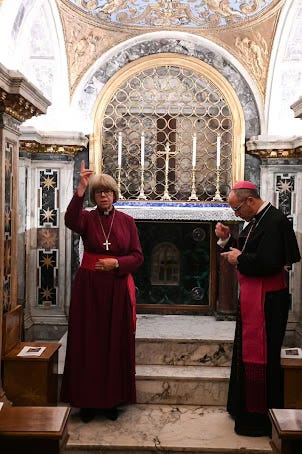
(Can Unity Be Built Without Truth? Lessons From Sarah Mullally’s Vatican Visit)
The conciliar revolutionaries, therefore, starting with Robert Francis Prevost/Leo XIV, made short work of Pope Leo XIII’s Apostolicae Curae and mocked the heroism of the English and Irish Martyrs who preferred to death rather than even to give the appearance of conferring legitimacy on that which is illegitimate and thus abhorrent in the sight of the true God of Divine Revelation, the Most Holy Trinity.
Now, readers will note that a supposed “archbishop,” Flavio Pace, who is the Secretary of the conciliar dicastery for “Promoting Christian Unity,” invited Sarah Elisabeth Bowser Mullally to give that fake, phony, fraud “blessing in the Clementine Chapel and that Jamie “Cardinal” Tagle of Manilla, The Philippines, preached at an Anglican liturgy held in the Church of St Ignatius of Loyola in Campo Marzio to install her own representative to the Holy See in its conciliar captivity.
In other words, two officials of what is believed by most people to be the Catholic Church participated in Anglican services even though a “deacon” within the Diocese of Lafayette, Louisiana, was excommunicated for joining an Anglican parish after he had been scandalized and disillusioned after his own son was the victim of clerical abuse and the presbyter pleaded in a court of law of the abuse but was nevertheless given a lavish farewell party by his parish before he reported to prison:
Scott Peyton has been waiting for a decision from the Vatican.
The Catholic deacon from Louisiana, who in May 2024 appealed his excommunication after leaving the church in the aftermath of his son's abuse case, has spent about two years waiting for a ruling from Rome.
The appeal remains unresolved, leaving his canonical status uncertain and extending a case that has drawn attention to the intersection of church law, pastoral practice and the handling of abuse-related disputes.
According to The Guardian, in May 2024 Peyton appealed formally against his excommunication to the Vatican's Dicastery for the Doctrine of the Faith.
The outcome could determine whether the excommunication was applied in accordance with canon law and how similar cases may be approached in the future.
Peyton, who was raised Methodist, entered the Catholic Church as an adult. His conversion, formalized in 2001, was followed by what he described as a deliberate effort by he and his wife Letitia to align their lives with Catholic faith and teaching. He and Letitia expanded their family to six children and became deeply embedded in Catholic parish life. As he stated in the personal narrative of his recourse to the Vatican, which was obtained by NCR with his permission, he even reversed his vasectomy operation to fully align with Catholic teaching on family life and sexuality.
Peyton wrote that in 2007, he discerned a vocation to the permanent diaconate. He was ordained in 2012 and assigned to St. Peter Catholic Church in Morrow, a small rural parish where the Peyton family had been parishioners since 2006. The community was tight-knit, and Peyton's family became closely connected to its then-pastor, Fr. Michael Guidry. Peyton wrote that the diocese assigned him to St. Peter at his request and at the request of Guidry.
Guidry was a frequent presence in the family's life, according to Peyton. Guidry invited the family to meals and praised their service. Peyton said his sons were very often at Guidry's house to help him out with daily work, and when they were there he would let them drink alcohol, unbeknownst to their parents.
"Because we had great regard for the office of the priesthood and had great trust in Father Guidry personally, it never occurred to any of us that he might be grooming our family for the purpose of committing child molestation," Peyton wrote in his recourse.
That trust was later broken. In May 2018, as later reported by OSV News, Peyton's son Oliver disclosed that, three years earlier, Guidry had plied him with alcohol and molested him. The revelation marked the beginning of a sequence of events that would alter the Peyton family's relationship with the church.
According to Peyton's recourse to the Vatican, Peyton and Oliver reported the incident to the sheriff's office May 21, the day after Oliver told his parents. Peyton wrote that the sheriff's office interviewed Guidry four days later on May 25.
According to Peyton, Guidry initially admitted to inappropriate conduct but was not arrested. Peyton wrote that on May 29 he reported the allegation to diocesan authorities. In his outline of events in his recourse, Peyton said that "the Diocese of Lafayette's officials initially appeared compassionate."
That perception shifted quickly.
According to Peyton, Bishop J. Douglas Deshotel of Lafayette publicly announced the allegation during parish Masses on June 2, 2018, the day of the wedding of Peyton's older son, providing details that made the family identifiable within their small community. Peyton wrote that the diocese also issued a statement announcing the allegation the same day. As OSV reported, Oliver Peyton's name was disclosed in a 2018 lawsuit and appeared in media reports.
"I cannot emphasize strongly enough how distressing the diocese's timing of the announcement, and the bishop's breaching the victim's anonymity, was for my family," Peyton wrote in his appeal to the Vatican.
He added that the disclosure forced the family into public view before they had informed relatives and exposed them to speculation and judgment.
The bishop held a press conference about the case on June 4. "Bishop Deshotel said that if the accusation were found not credible, Father Guidry would be returned to ministry," Peyton wrote.
Peyton's canon lawyer provided NCR with a link to video posted by NewsTalk 96.5 KPEL, that contains audio from the June 4, 2018, press conference. During the press conference, Deshotel said, "First we let the civil authorities determine through their investigation exactly what happened, and if it was criminal or not. If it was not, then Father can be restored and his good name restored also."
Peyton contended that this suggested uncertainty about the credibility of the allegation, despite Guidry's admissions to police on May 25.
"By floating the possibility that the accusation might not be credible when he knew well that it was, the bishop gave Father Guidry an opening to claim to his supporters that the bishop knew that he was innocent," Peyton wrote in his account of events contained in the Vatican recourse.
During the press conference, Deshotel, answering questions from reporters about who reported the abuse to the diocese and where the abuse took place, said that the victim's parents were now attending church in Ville Platte, Louisiana. (In 2017 Peyton was transferred to another parish, Sacred Heart in Ville Platte.)
Deshotel also said during the press conference that the diocese provides crisis counseling for anyone suffering from abuse. Peyton wrote that shortly after the press conference, four members of the family began to receive counseling that was paid for by the diocese. He said the diocese later warned them that it would stop paying for counseling if they filed suit.
In his account, Peyton also said:
On June 13, 2018, Father Guidry was interviewed by police with his criminal attorney present. This time, he confessed to the molestation in a manner that was criminally actionable. The following day, June 14, he turned himself in to the police, was arrested and charged, and was released on bond.
Guidry was ultimately sentenced to prison. Yet Peyton said in his account that the parish response from St. Peter favored the priest.
He said in his recourse that parishioners assisted Guidry in moving from the rectory in July 2018, and held a luncheon for him after his admission. Others, he said, spread rumors challenging his son's account. He felt his family's standing in the community deteriorated and said he experienced isolation, strained relationships and a lack of support from clergy.
"Out of the more than one hundred deacons in the Diocese of Lafayette, only about six of them continued to offer me the hand of brotherhood," he wrote.
Peyton's Vatican recourse account aligns with his March 27 interview with the National Catholic Reporter, where he described the broader impact of what happened to his family's faith.
Peyton continued to serve as a deacon for a time, but tensions with diocesan leadership intensified. According to his recourse, in August 2018, the family filed a civil lawsuit against Guidry and the Diocese of Lafayette. Peyton wrote that, immediately after filing, he was warned by clergy that he might be removed from the clerical state.
"At that rate, I would be removed from the clerical state before the priest who molested my son," he wrote.
The Diocese of Lafayette did not respond to a request for comment from NCR, and has not confirmed whether Guidry has been laicized.
In 2021, the civil case was settled. The diocese announced it found the allegations credible and that Guidry had been permanently removed from ministry. The statement included a brief apology to Oliver and his family referring to the actions of Guidry but, according to Peyton, did not address other aspects of the family's experience.
Following the settlement, Peyton wrote that the diocese immediately stopped providing counseling. Peyton and his family established a nonprofit organization to support abuse victims and advocate for reform. At the same time, their relationship with the church continued to deteriorate. In his interview with NCR, Peyton said attending Mass after the abuse became public as a painful experience.
"We were simply going to check the boxes. Everything in there reminded us of why we were in the situation," he said.
Eventually, the family began attending an Anglican congregation, seeking distance from the environment associated with the trauma.
His departure from the Catholic Church was formalized in a December 2023 letter to Deshotel, resigning from active ministry. Peyton said that the tone of the bishop's initial response was understanding, which was verified in the bishop's email, included in the recourse.
Months later, in March 2024, however, Peyton received a decree of excommunication from his bishop.
"It was kind of one of these things that go like, 'You can't quit, we fire you,' " he said.
The canonical basis for the excommunication — which is considered one of the gravest canonic acts a Catholic bishop could impose — was contested. Dawn Eden Goldstein, the canon lawyer who represents Peyton pro bono, said to NCR that the bishop's decision to impose a formal penalty was unwarranted and pastorally harmful.
"I was appalled by what I saw as a total pastoral failure on the part of the diocese," she said.
Goldstein emphasized that Peyton had not publicly presented himself as continuing in Catholic ministry after his resignation and that his actions did not create the kind of scandal that would require an imposed excommunication.
"It was not at all clear to me that the bishop had tried in any way to seek other, more pastoral, remedies," she said.
Her May 2024 appeal to the Vatican seeks to overturn the decree. The case has remained unresolved for nearly two years.
Advertisement
According to canon lawyer Nicholas Cafardi, former dean of the Thomas R. Kline School of Law of Duquesne University, the central issue in this case is not the bishop's action but the canonical concept of schism. In his view, schism constitutes a rupture of communion with the Catholic Church, specifically a rejection of the authority of the pope. Under canon law, he said, such a rupture carries an automatic penalty.
"He excommunicated himself by going into schism," Cafardi said, referring to the principle of latae sententiae, commonly known as immediate and automatic excommunication, which is incurred by the act in itself rather than imposed by a bishop. A schism usually occurs when an ordained church member officially separates himself from the church authority and hierarchy over doctrinal and organizational disagreements.
Cafardi emphasized that excommunication in this context is not intended as a punitive measure in a conventional sense, but as what canon law describes as a "medicinal" penalty. The effect of the penalty is that the individual may no longer exercise ecclesiastical ministry or function in a clerical role and is no longer considered to be in full communion with the church. At the same time, the purpose of the penalty is corrective, aimed at encouraging reconciliation.
In practical terms, Cafardi said, reconciliation would require the individual to renounce the schism and formally return to the church, typically through a profession of faith. Once that step is taken, the penalty can be lifted by ecclesiastical authority. Until then, he said, the situation reflects the consequences established by canon law for a break in communion.
Goldstein focused less on the act of departure and more on the circumstances that led to it. In a May 14 letter to Vatican authorities included in Peyton's recourse, she said that canon law must take into account whether a person intended to break with the church or acted under pressure.
Drawing an analogy from church marriage law, she suggested that just as a spouse may be justified in leaving a harmful situation, Peyton's departure should be evaluated in light of what she described as "the Diocese's continued pastoral failures and outright antagonism" that "placed his children in grave danger of losing their Christian faith."
Goldstein wrote that the excommunication against Peyton was not a "medicinal" penalty: "Rather, it has the appearance of a punishment for his successfully suing the Diocese of Lafayette, and it is causing grave harm to his family."
In her interview with NCR, Goldstein also questioned the process that led to the excommunication, emphasizing what she described as a lack of pastoral engagement. "The bishop had a responsibility to speak and meet with him and dialogue with him," she said, adding that she saw no indication that such outreach occurred after Peyton submitted his resignation.
While acknowledging that Peyton could have been aware of the possibility of automatic excommunication because of his theological education, she argued that his conduct did not rise to the level of public defiance or scandal that would justify a formal, imposed excommunication. From her perspective, the case raises broader questions about how canon law is applied when personal circumstances, including trauma and failures to provide community support and pastoral care, shape a cleric's decision to leave.
"I believe that Pope Francis and Pope Leo now would agree that regardless of where the law is on this case, Deacon Peyton has a right to closure. He has a right to resolution," she said. "And people everywhere who have stepped away from the Catholic Church out of the pain and anger caused by the abuse crisis have a right to know: Does the church consider them excommunicated because of their pain, their anger having led them to forego Catholic worship?"
Talking to NCR, Peyton described his brief attendance at an Anglican church as a response to what he and his family experienced in Catholic settings after the abuse became public. "We weren't being strengthened by going to Mass," he said. "So we tried to choose some place that would offer some help and feed us spiritually."
He also rejected the suggestion that he intended to incur excommunication. "That was never the case," Peyton said, pointing to his written resignation to the bishop, which he said was meant to clarify that he was stepping away without seeking to provoke a canonical penalty. He indeed noted that the bishop's initial response was "pastoral" and did not warn of excommunication, which came only about three months later in March 2024. During that period, Peyton and his family had begun speaking publicly about abuse and advocating for legislative changes in Louisiana.
"When Guidry gets out of prison in a year or so, he can honestly say he is a Catholic priest, whereas my son can see that his father cannot say 'I'm a Catholic deacon,' or that I'm even welcome in the church, because we just cannot torture ourselves."
"Two years of dragging this on, I want to know where Rome stands," he said. "I want Rome to answer." (Louisiana deacon awaits Vatican decision on his excommunication.)
I am not justifying Mr. Peyton’s decision to leave what he thinks is the Catholic Church nor less yet justifying his joining a local Anglican sect. Not at all.
Mr. Peyton obviously was not catechized properly about the nature of the Catholic Church as the one and only true Church founded by Our Blessed Lord and Saviour Jesus Christ and he certainly demonstrates no familiarity with the long and very well document history of clerical abuse cases within the conciliar sect, something that intend to write about in a week to ten days.
However, I have cited his case to point out what should be very obvious to those who read this commentary, namely, that Mrs. Sarah Elisabeth Bowser Mullally, who is not a member of the Catholic Church and, quite to the contrary, claims to be the “archbishop” of Canterbury and is at odds with Holy Mother Church’s teaching on Faith and Morals, was welcomed and feted by “Pope Leo XIV, Jaime Tagle, Flavio Pace, and other false shepherds as a “minister of the Gospel” who is not threatened with excommunication while the full force of the conciliar sect’s “mercy” was bestowed upon Mr. Scott Peyton for joining a “church” that is part of the same Worldwide Anglican Communion of which Mrs. Mullally is the spiritual head.
The hypocrisy is astounding.
We must, of course, continue praying to Our Lady, especially through her Most Holy Rosary, for the conversion of all non-Catholics, which include the conciliar revolutionaries themselves, and for the restoration of a true pope on the Throne of Saint Peter as the fruit of the Triumph of the Immaculate Heart of Mary.
Our Lady of the Rosary, pray for us!
Saint Joseph, pray for us.
Saints Peter and Paul, pray for us.
Saint John the Baptist, pray for us.
Saint John the Evangelist, pray for us.
Saint Andrew the Apostle, pray for us.
Saint Michael the Archangel, pray for us
Saint Gabriel the Archangel, pray for us.
Saint Raphael the Archangel, pray for us.
Saints Joachim and Anne, pray for us.bec
Saints Caspar, Melchior, and Balthasar, pray for us.
Saint Peter of Verona, pray for us.